
Before the monsoon finds it
Slope & Wash Erosion Control in Phoenix, AZ
Cut slopes, basin banks and wash edges covered with mulch, blankets or matrix so storm runoff has nothing loose to carry.
- We look at your lot at no charge and quote it in writing
- Seed picked for the season: bermuda in summer, ryegrass in fall, natives for desert ground
- A written watering plan with every new seeding
Seven Inches of Rain, Most of It at Once
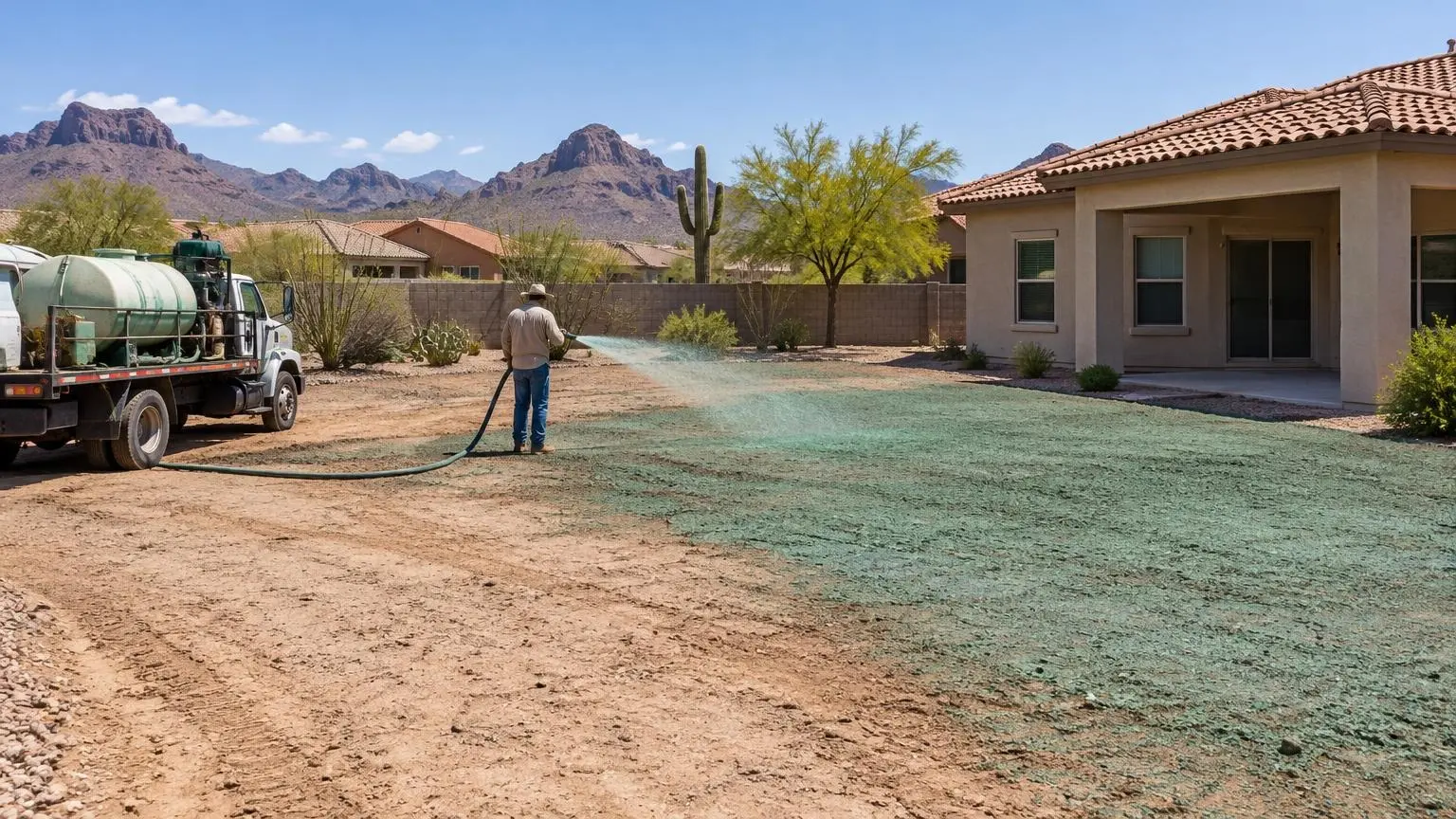
Slope and wash erosion control in Phoenix is about a few hard storms, not steady rain. Sky Harbor averages 7.22 inches a year, but July and August each average close to an inch, often in short, intense monsoon cells that drop it on bare ground in minutes. When that water hits a fresh cut slope, a basin bank or the edge of a wash, it pulls soil downhill in rills and dumps it in the street, a neighbor's yard or a storm drain. Our erosion control services cover the slope with something that holds: hydromulch, bonded fiber matrix, erosion control blankets or a combination, usually with seed in the mix so vegetation takes over the job.
Where erosion shows up in the Valley
Phoenix is mostly flat, but the city wraps around mountains: Camelback, North Mountain, Piestewa Peak and South Mountain sit inside the valley, and the McDowells, White Tanks, Superstitions and Sierra Estrella ring it. Foothill lots on those edges come with cut and fill banks. On the flat ground, the problem spots are retention basins, drainage swales along lot lines, channel banks and anything graded near a wash. The Salt River's bed through Phoenix is often dry because of irrigation diversions, and many smaller washes look the same most of the year, which is why people build too close to them.
Matching the cover to the slope
- Hydromulch (hydro mulching): wood or paper fiber sprayed with tackifier, with or without seed. Good for gentle slopes and flats where wind and light runoff are the threat.
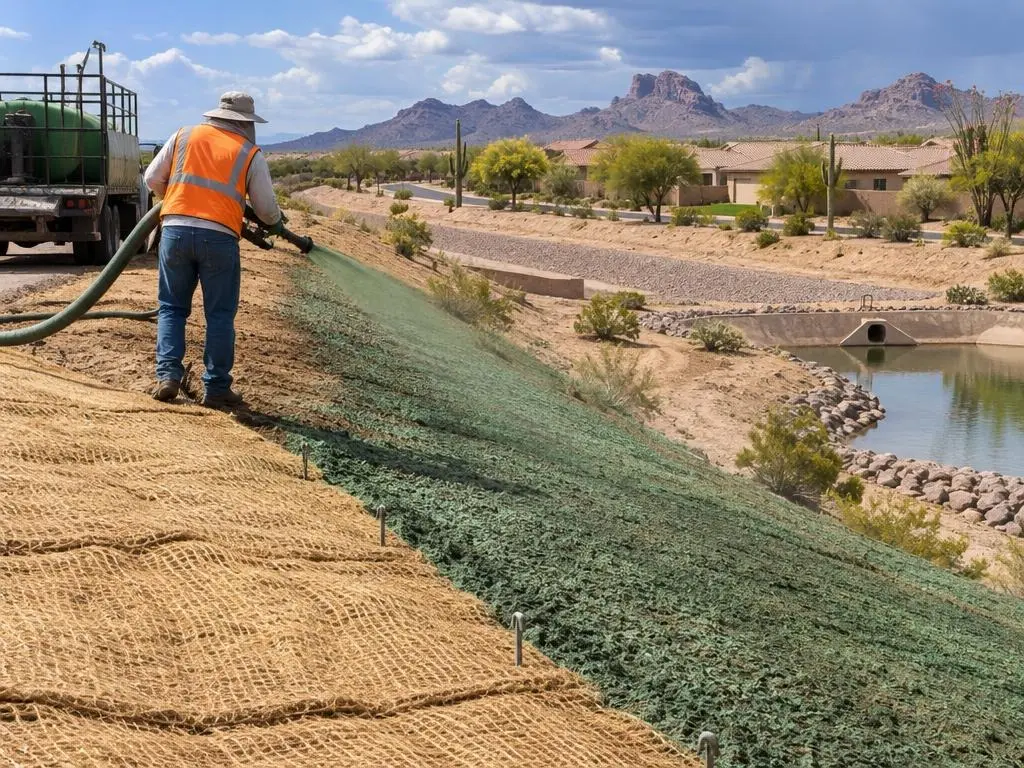
- Bonded fiber matrix: a heavier sprayed mulch mixed with a binder; once cured it forms one unbroken layer that still lets water through. Used on steeper cut slopes where a blanket would be hard to anchor or rock is close to the surface.
- Erosion control blankets: rolled mats of straw, coir, or a straw and coconut blend, staked down over seed. These are the choice in swales and channel lines where water concentrates, and on basin side slopes.
- Straw blankets plus hydroseed: seed sprayed first, blanket over the top, for slopes that need both seed contact and protection from the first storm.
Slope stabilization and the grading code
The City of Phoenix grading code treats slopes seriously. Excavations that create a cut slope more than five feet high and steeper than 1 vertical to 1.5 horizontal fall outside the permit exemptions, and any clearing or grading on land the zoning ordinance designates as hillside needs a permit regardless of size. Work in or over a natural watercourse, drainageway, arroyo or other flood hazard area needs a grading permit too. When those permits come with an approved plan, our slope stabilization follows it. On small residential banks below those thresholds, we size the treatment to the slope and the drainage area above it.
Timing and the monsoon
The National Weather Service runs Phoenix's monsoon season from June 15 through September 30. Slopes graded in spring should be covered before mid-June. Bermuda seed in the mix will germinate under irrigation in summer; on unirrigated slopes we often spray hydromulch now for immediate cover and add a native seed mix in the fall, when Valley water-conservation guidance says desert natives should be sown. Blanket and matrix work can happen any time the ground is not saturated.
What erosion control contractors should tell you
Good erosion control contractors start with where the water comes from, not just the slope face. If a downspout or a driveway sheet-flows over the top of a bank, no blanket will hold for long. We look at the drainage above, add a diversion or rock-lined outlet where needed, and then pick the cover. We also tell you what the treatment will not do: hydromulch is not a substitute for a retaining wall, and a blanket on an actively failing slope is a temporary fix.
Basins and swales on flat lots
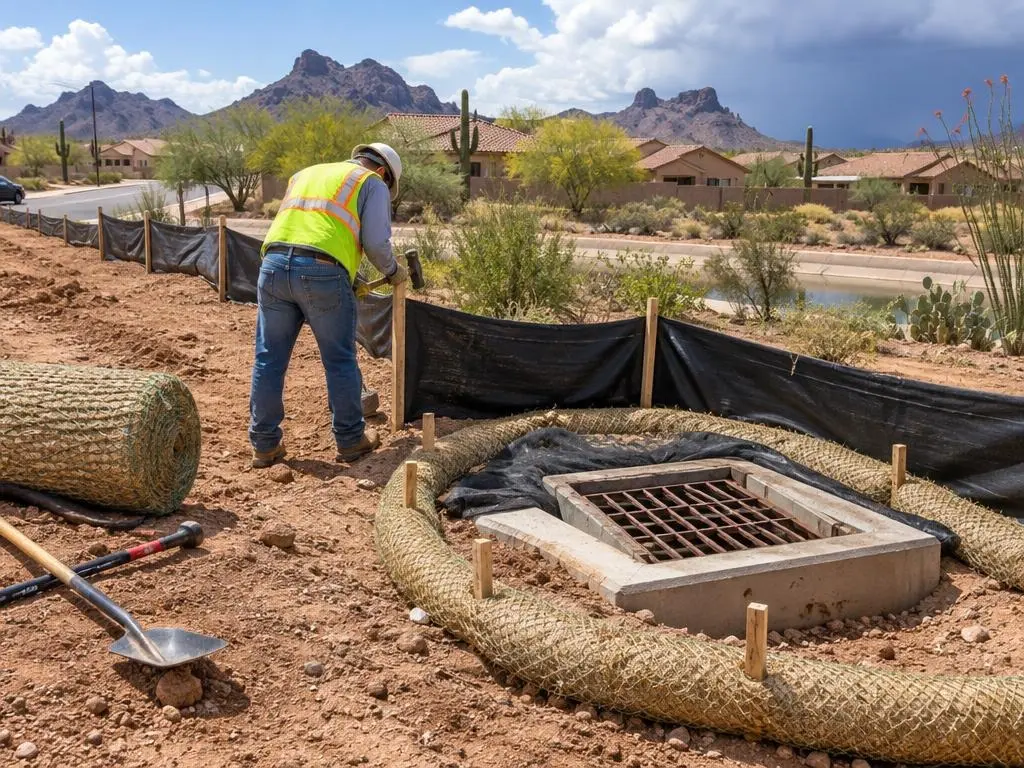
Because so much of Phoenix is flat, a lot of stormwater is handled by retention: shallow basins in front yards, common-area basins in subdivisions, and swales that steer water to them. Their side slopes are short but steep, and they take the full flow from the street or the roof in every storm. Bare basin banks erode into the bottom, filling the basin and shortening the time it takes to overflow. We line the inflow points with rock or blankets, cover the banks with blankets or bonded fiber matrix, and seed the bottom with bermuda where it is irrigated or a native mix where it is not.
Wind is erosion too
Not all soil loss here is from water. Monsoon outflow winds and dust storms, which can build into a haboob, strip loose dirt off bare ground just as surely as a flash flood moves it downhill. A tackified hydromulch layer is often the first line of defense on a graded lot in early summer, before the first storm cells arrive.
After installation
New cover is checked after the first big storm. Rills get filled and resprayed, blankets with lifted edges get re-staked, and any undercut at the toe is fixed before the next cell.
Erosion Control Options
Covers sized to the slope, the soil and the water above it.
Hydromulch
Fiber mulch and tackifier for flats and gentle slopes, with or without seed.
Bonded fiber matrix
Heavier sprayed matrix for steep cut slopes and rocky banks.
Straw and coir blankets
Erosion control blankets staked over seed in swales and on basin slopes.
Swale and channel lining
Blankets and seed where runoff concentrates.
Wash bank stabilization
Cover and seeding for graded edges near washes and drainageways.
Outlet and downspout fixes
Rock outlets and diversions so water stops cutting the slope.
Typical Erosion Control Costs
| Item | Typical range |
|---|---|
| Wood-fiber hydromulch, sprayed, each 1,000 sq ft (a transportation agency 2025 rate list) | $98 |
| 70% straw / 30% coconut mat, each 1,000 sq ft (same list) | $468 |
| All-coir mat, each 1,000 sq ft (same list) | $532 |
| Erosion seed spread by hand, per acre (same list) | $372 |
| Steep slope surcharge on hydroseeding, per sq ft (HomeGuide) | $0.05 to $0.10 |
| Bonded fiber matrix | Quoted once we see the slope |
Agency rate-schedule and national figures, not Phoenix quotes. We could not find a current published figure for BFM, so it is quoted slope by slope. National numbers for context; we put a firm number in writing after the visit.
How We Stabilize a Slope
1. Find the water
We trace runoff above the slope and look at the outlet below.
2. Fix the drainage
Diversions, downspout extensions or rock outlets as needed.
3. Prep the face
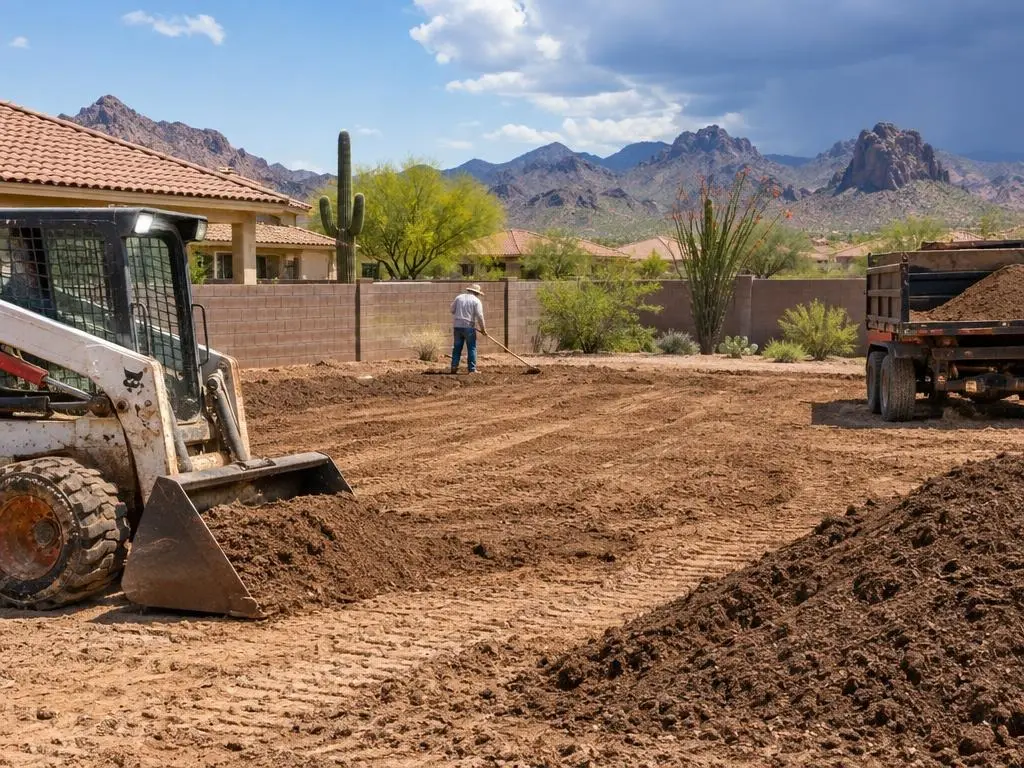
Track-walk or rough the surface so mulch and seed grip.
4. Apply cover
Hydromulch, matrix or blankets, with seed where it will grow.
5. Storm check
Inspect and repair after the first heavy rain.
Why Choose Us for Slope & Wash Erosion Control
Drainage first
We fix the water above the slope before we cover it.
The right cover
Blankets where water concentrates, sprayed matrix where blankets will not anchor.
Honest limits
We tell you when a slope needs a wall or an engineer, not mulch.
Slope & Wash Erosion Control Questions
Is hydromulch enough for a steep slope?
On gentle slopes, often yes. On steeper cut slopes or where water runs over the top, bonded fiber matrix or erosion control blankets hold much better. We decide by slope, soil and drainage area.
When should slopes be covered in Phoenix?
Before the monsoon, which the National Weather Service dates from June 15. Anything graded in spring should be covered by then.
Do I need a permit to work on a wash bank?
In Phoenix, grading in or over a natural watercourse, drainageway or arroyo requires a grading permit. Check with the city before regrading near a wash; we can install the treatment shown on an approved plan.
Will grass grow on an unirrigated slope?
Not bermuda. Unirrigated desert slopes do better with a native seed mix sown in fall, with hydromulch or blankets for cover until it establishes.
Slope & Wash Erosion Control Service Areas
- Hydroseeding in Phoenix, AZ
- Hydroseeding in Scottsdale, AZ
- Hydroseeding in Mesa, AZ
- Hydroseeding in Chandler, AZ
- Hydroseeding in Gilbert, AZ
- Hydroseeding in Tempe, AZ
- Hydroseeding in Glendale, AZ
- Hydroseeding in Peoria, AZ
- Hydroseeding in Surprise, AZ
- Hydroseeding in Goodyear, AZ
- Hydroseeding in Avondale, AZ
- Hydroseeding in Buckeye, AZ
- Hydroseeding in Queen Creek, AZ
- Hydroseeding in San Tan Valley, AZ
- Hydroseeding in Maricopa, AZ
- Hydroseeding in Apache Junction, AZ
- Hydroseeding in Fountain Hills, AZ
- Hydroseeding in Paradise Valley, AZ
- Hydroseeding in Cave Creek, AZ
- Hydroseeding in Carefree, AZ
- Hydroseeding in Anthem, AZ
- Hydroseeding in El Mirage, AZ
- Hydroseeding in Litchfield Park, AZ
Get a Slope & Wash Erosion Control Estimate
Get a slope looked at before the next storm.